Need help? Text us Mon-Fri | 8AM-6PM EST
(412) 910-8567
Lyophilization, commonly known as freeze-drying, is a preservation process used throughout the pharmaceutical and biotechnology industries to improve the stability and shelf life of sensitive compounds. Many research peptides are supplied in a lyophilized form because the process helps protect the material during storage and transport.
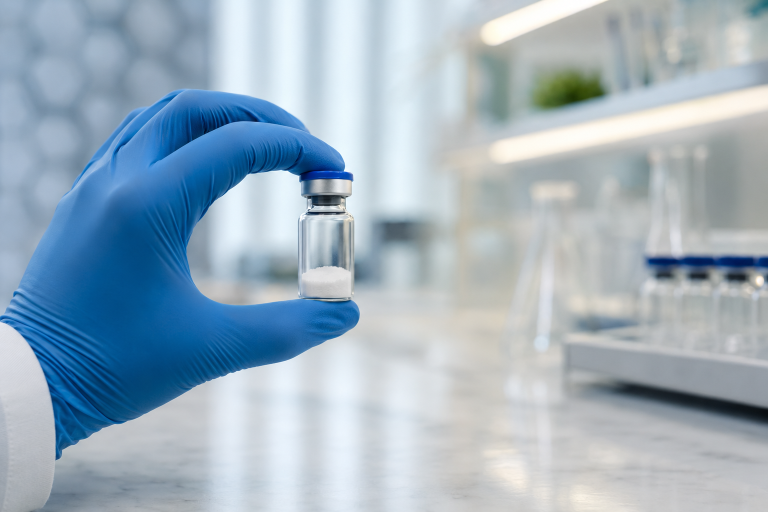
While most researchers are familiar with the appearance of a lyophilized peptide—a dry white cake or powder inside a vial—the science behind the process is often misunderstood. Understanding lyophilization can help researchers better evaluate product quality, storage requirements, and handling procedures.
Lyophilization is a dehydration process that removes water from a material while preserving its structure. Rather than evaporating water through heat, lyophilization removes frozen water through a process called sublimation, where ice transitions directly from a solid to a vapor.
This approach is particularly useful for sensitive biological materials that may be damaged by traditional drying methods.
Many peptides are susceptible to degradation when stored in solution for extended periods. Moisture can accelerate chemical reactions that reduce stability and shorten shelf life.
By removing water, lyophilization helps:
Improve long-term stability
Reduce degradation during storage
Simplify shipping and handling
Preserve material integrity
Extend usable shelf life under appropriate storage conditions
For these reasons, lyophilization has become a standard practice throughout the peptide and pharmaceutical industries.
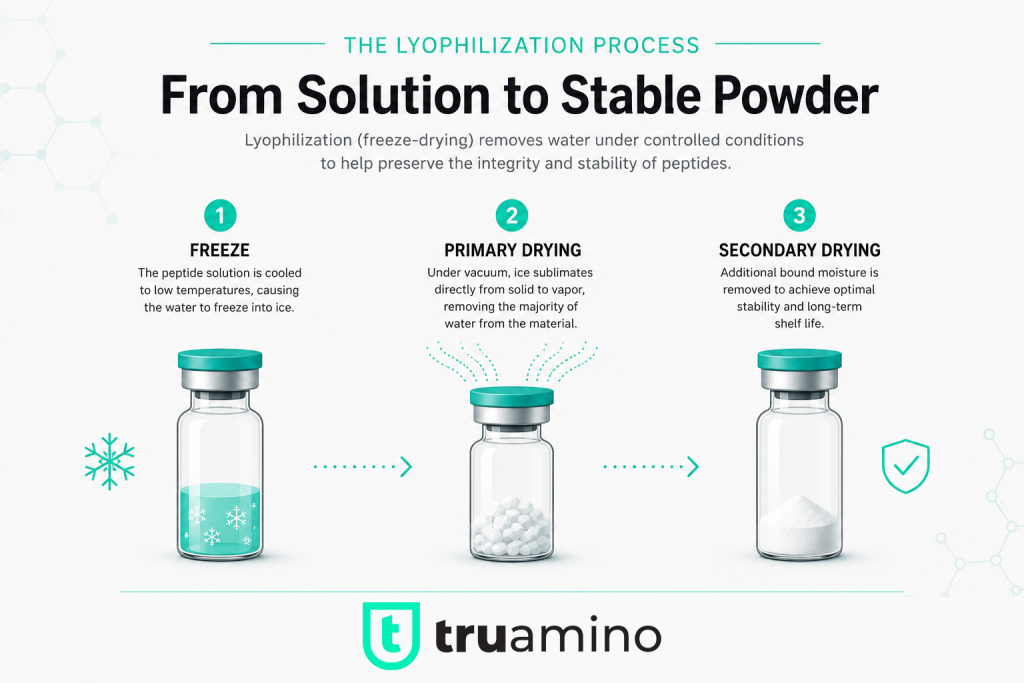
The freeze-drying process generally consists of three stages:
The peptide solution is cooled until the water inside the vial freezes completely.
Under vacuum conditions, frozen water is removed through sublimation. Rather than melting into liquid water, the ice transitions directly into vapor and exits the product.
Residual moisture is removed to achieve the desired level of dryness and stability.
Once complete, the vial is sealed to protect the material from environmental moisture.
A properly lyophilized peptide often appears as a dry white cake adhered to the bottom of the vial.
However, appearance alone should never be used as a measure of quality. Different formulations can produce cakes that vary in texture, shape, and density.
Some common appearances include:
Smooth uniform cakes
Slightly shrunken cakes
Porous or sponge-like structures
Thin powder layers
While significant discoloration or obvious moisture may indicate problems, visual inspection cannot confirm identity, purity, sterility, or potency.
No.
One of the most common misconceptions in the research community is that a visually appealing lyophilized cake guarantees product quality.
Appearance provides very limited information about the actual contents of a vial.
A vial may contain a perfectly formed cake while still failing important quality metrics such as:
Identity
Purity
Quantitation
Sterility
Endotoxin limits
Heavy metal screening
Analytical testing—not appearance—is the only reliable way to verify product quality.
When properly performed, lyophilization is designed to preserve peptide integrity rather than alter it.
The goal is to minimize degradation and maintain stability throughout storage and transport. However, the effectiveness of the process depends on manufacturing controls, formulation design, and storage conditions.
This is one reason why third-party testing remains an important part of quality assurance.
Storage recommendations may vary depending on the specific material, but researchers generally seek to minimize exposure to:
Heat
Moisture
Direct sunlight
Frequent temperature fluctuations
Moisture is one of the most significant threats to long-term stability. Once a vial is exposed to humidity, degradation risks may increase.
Researchers should always consult available documentation and handling guidance for their specific material.
Not necessarily. Lyophilization and sterility are separate concepts. Sterility must be verified through appropriate testing procedures.
Appearance alone cannot verify identity, purity, sterility, potency, or safety.
Lyophilization can improve stability, but no preservation method completely eliminates degradation risks.
Different formulations and manufacturing processes can produce different visual appearances while remaining within acceptable specifications.
Lyophilization is a specialized freeze-drying process used to improve the stability and shelf life of sensitive compounds, including many research peptides. By removing water under carefully controlled conditions, manufacturers can better preserve product integrity during storage and transport.
While the appearance of a lyophilized cake may offer limited visual clues, meaningful quality assessment requires analytical testing. Identity, purity, quantitation, sterility, endotoxin screening, and heavy metal analysis provide a far more complete picture of product quality than appearance alone.
For researchers evaluating materials, understanding lyophilization is an important first step—but verified testing data remains the gold standard.
Lyophilization is a freeze-drying process that removes water through sublimation, helping improve the stability of sensitive materials.
Freeze-drying helps reduce moisture-related degradation and can improve long-term stability during storage.
No. Sterility and lyophilization are separate processes and must be evaluated independently.
No. Appearance alone cannot verify identity, purity, sterility, potency, or safety.
Analytical testing is necessary to verify identity, purity, quantitation, sterility, endotoxin limits, and other quality attributes.
ustries to improve the stability and shelf life of sensitive compounds. Many research peptides are supplied in a lyophilized form because the process helps protect the material during storage and transport.
While most researchers are familiar with the appearance of a lyophilized peptide—a dry white cake or powder inside a vial—the science behind the process is often misunderstood. Understanding lyophilization can help researchers better evaluate product quality, storage requirements, and handling procedures.
Lyophilization is a dehydration process that removes water from a material while preserving its structure. Rather than evaporating water through heat, lyophilization removes frozen water through a process called sublimation, where ice transitions directly from a solid to a vapor.
This approach is particularly useful for sensitive biological materials that may be damaged by traditional drying methods.
Many peptides are susceptible to degradation when stored in solution for extended periods. Moisture can accelerate chemical reactions that reduce stability and shorten shelf life.
By removing water, lyophilization helps:
Improve long-term stability
Reduce degradation during storage
Simplify shipping and handling
Preserve material integrity
Extend usable shelf life under appropriate storage conditions
For these reasons, lyophilization has become a standard practice throughout the peptide and pharmaceutical industries.

To help maintain our quality standards and research-focused environment, an account is required to view pricing, access product information, and place orders.

Lorem ipsum dolor sit amet, consectetur adipiscing elit.

Independently tested by ISO/IEC 17025 accredited laboratories

Same-day shipping on orders placed before 4 PM MT.